Beth Henshaw
For the last year I’ve gone swimming, kayaking and canoeing on the lake, never making it more than a few miles from a marina. But this past week I took my first motorboat camping trip out on Lake Powell.
Glen Canyon- once a calm, rapid free stretch of river that any boy scout with an inner tube could float. Glen Canyon- a tranquil section of the Colorado River that flowed effortlessly between narrow canyons. Glen Canyon- a lake named Powell now.
Finally, I’ll get to see more of Glen Canyon. This reservoir has over 2,000 miles of shoreline only accessible by boat. And I do not recommend trying to paddle all those miles. I’ve had some scary trips out on the lake with 60 m.p.h. headwinds and big waves that sink the canoe surrounded by 1,000 foot sheer vertical walls. It’s an unforgiving place in a canoe.
Just the mention of Lake Powell sparks controversy- some people call the national recreation area a scenic treasure, while others view it as one of the biggest environmental tragedies of our time. Fill Lake Powell, drain Lake Powell, it’s a hot topic.
As we loaded the motor boat with enough groceries and water to last the week, there was this nagging voice inside my head when I looked out at the reservoir. I felt that there was something wrong, something off about this place.
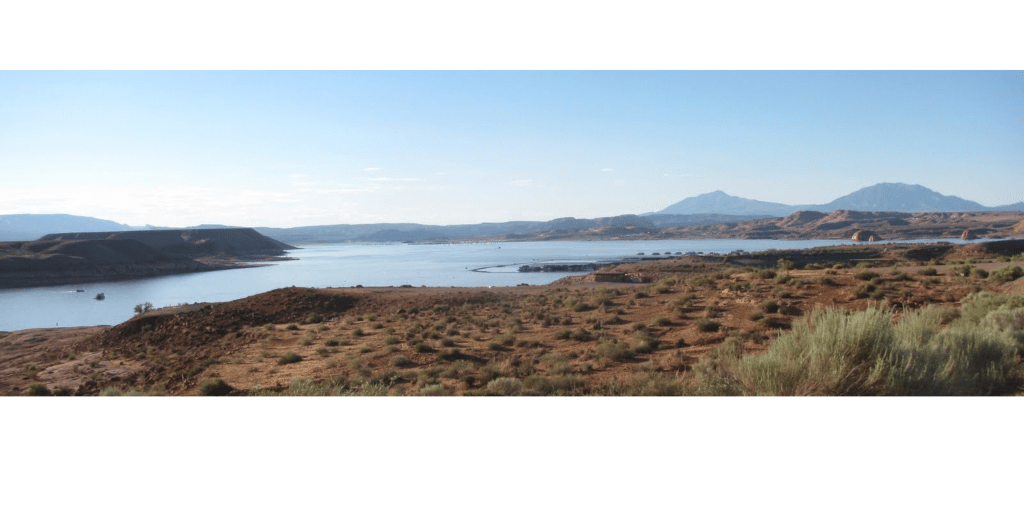
We drove more than a hundred miles around the lake and didn’t see a single mature tree. Just rock and water. A thousand foot cliff next to a 300 foot deep lake. For long stretches of the lake, there is no shoreline, no sandy beaches, no where to dock your boat. You just gotta keep driving until you pass the cliffs of rock and waves of water, hoping you’ll find a patch of sand where a gigantic houseboat isn’t already parked. As the lake levels drop, campsites are harder to find.
It is perplexing to see so much water in a dry desert landscape of rock and crumbling sand. A barren place where water shouldn’t be…it is abundant here. Lake Powell is at its core unnatural, because more water does not equal more life here.
Lake Powell is a place of juxtapositions. At every turn, there is mind boggling beauty and yet an unsettling uncertainty permeates the charm. The reflections of stone on water are mesmerizing to watch. More common in the early morning or evening, when the water is still, the clouds are free to float the ripples. The canyons are doubled as they appear perfectly mirrored in the water. Gliding next to the tall walls of orange and black set against the azure sky is enough to make you want to stay another day.
But there was hardly any ecosystem on the lake. Without so much as a branch for migratory birds to land on, when you cut the engine of the boat a deafening and beautiful silence fills the air. No cottonwood leaves swaying against the breeze, no twigs of juniper or pinyon to step on, no oak leaves crunching under my feet. No chorus of canyon wrens, finches, and swallows were heard out on the lake.
The animals that I could see on the lake were out of place. Lots of ducks. Invasive quagga mussels, native to the Black Sea, probably brought over by some tourists, lined the canyon walls that used to be underwater, clung to the cracks. To develop sport fishing on the lake, non-native rainbow and brown trout, common carp, channel catfish, and bullhead species, striped and smallmouth bass were introduced and have since taken over.
When we could find a patch of land to dock the boat on, it was usually bare rock or deep sand. So bare it didn’t even include its usual assortment of prickly pears, yucca, prince’s plum, moonflower, or primrose.
Why?
Because what land we see now was submerged underwater for twenty years. The land we see today is “supposed” to be under water, but Lake Powell is drying up.
According to the Lake Powell Water Database, Lake Powell is about 33% full and 134 feet below full pool as of May 28, 2024. The last time Lake Powell was considered full was in the 1980s, and the high water left a mark on the red canyon walls, known as the “Bathtub ring.”
Aside from the occasional blue heron and jumping fish, the lake seemed dead. As the boat bounced over waves and wandered through glassy side canyons, I couldn’t help but wonder- what happened to the animals who called this canyon home?
Without warning, the canyons began to fill in the 1960’s.
How many creatures stayed loyal to their homes and died in the midst of the never ending flood? An animal’s apocalypse. Suddenly, their ancestral memories of periodic flash floods were useless.
Quickly, they needed to adapt to new information: the water is rising, rising, rising not flashing, not flooding, but filling. Never receding, never stopping, rising.
How many animals knew instinctively to flee? And where could those critters go when they encountered a cliff? Realizing for the first time that their neighborhood is a cul de sac of stone. Never before needing to climb to survive.
So many lives lost to the reservoir.
Still, some creatures survived. I wondered what new adaptations they have developed in such a short time. In just a lifetime, creatures needed to relearn everything. Where is food, where is shelter, how do I drink water without falling off this cliff? Where there were once beaches, caves, river banks, swamps, shallow pools, now there is just deep water.
Each day we left the main channel of what would be the Colorado River to explore the side canyons and tributaries. My favorite thing to do was drive to the end of each canyon, the end of each tributary, not stopping until we found the end of the lake. Tucked back in those coves, some desert ecosystems re-emerged.
Stands of ancient dead cottonwoods rose out of the lake, their top branches poking out of the water. But walk down a canyon that is no longer drowned under Powell and you’ll see new cottonwoods and willows sprouting from the sediment.
We watched a coyote wander the rocky shore of Last Chance Bay, a long tributary into the Colorado River. It scoured the shore looking for a place to dip its mouth in for a drink without falling to its death.
I wondered what the coyote ate. In three days, I hadn’t seen more than a handful of prickly pear cactus, when they normally cover the ground in every direction. There were no frogs in the deep lake, without shore and shallow water to live on. There were no juniper trees to pick seeds from in the last hundred miles of shoreline. And how could little rodents and rabbits traverse the islands in between depths of the lake. Insects and lizards can’t be enough to sustain an entire coyote population.
Yet, there’s one running along the rocky shore, surviving. And it’s beautiful to see a creature adapt. That’s the magic of the desert. Animals and plants surviving in seemingly un-liveable conditions. Summers that rise into triple digits and winters that drop below freezing. Dry and arid, sparse and harsh.
Lake Powell is strange, other worldly, impossible to compare to other reservoirs and lakes. A lost desert river ecosystem replaced by a deep lake. Both immensely beautiful and alluring. Both are worth exploring.
As we drove into the slot canyons and found the end of Lake Powell’s waters turned to stone, I couldn’t help but wonder if there will be a day in my lifetime that I get to see Glen Canyon as a river. I couldn’t help but wonder what the river looked like before it was damed. And I can’t help but wonder what it might look like after Lake Powell is gone.

Beth Henshaw is a writer based in desert southwest. She is published in Durango Magazine, Four Corners Voices Anthology, and Canyon Voices Literary Magazine. More of her work can be found on her Instagram @blog_by_beth and on her website www.empathicadventurers.com. Beth is pursuing her M.F.A. in creative writing at Western Colorado University.
 Morrow Point
Leave a comment