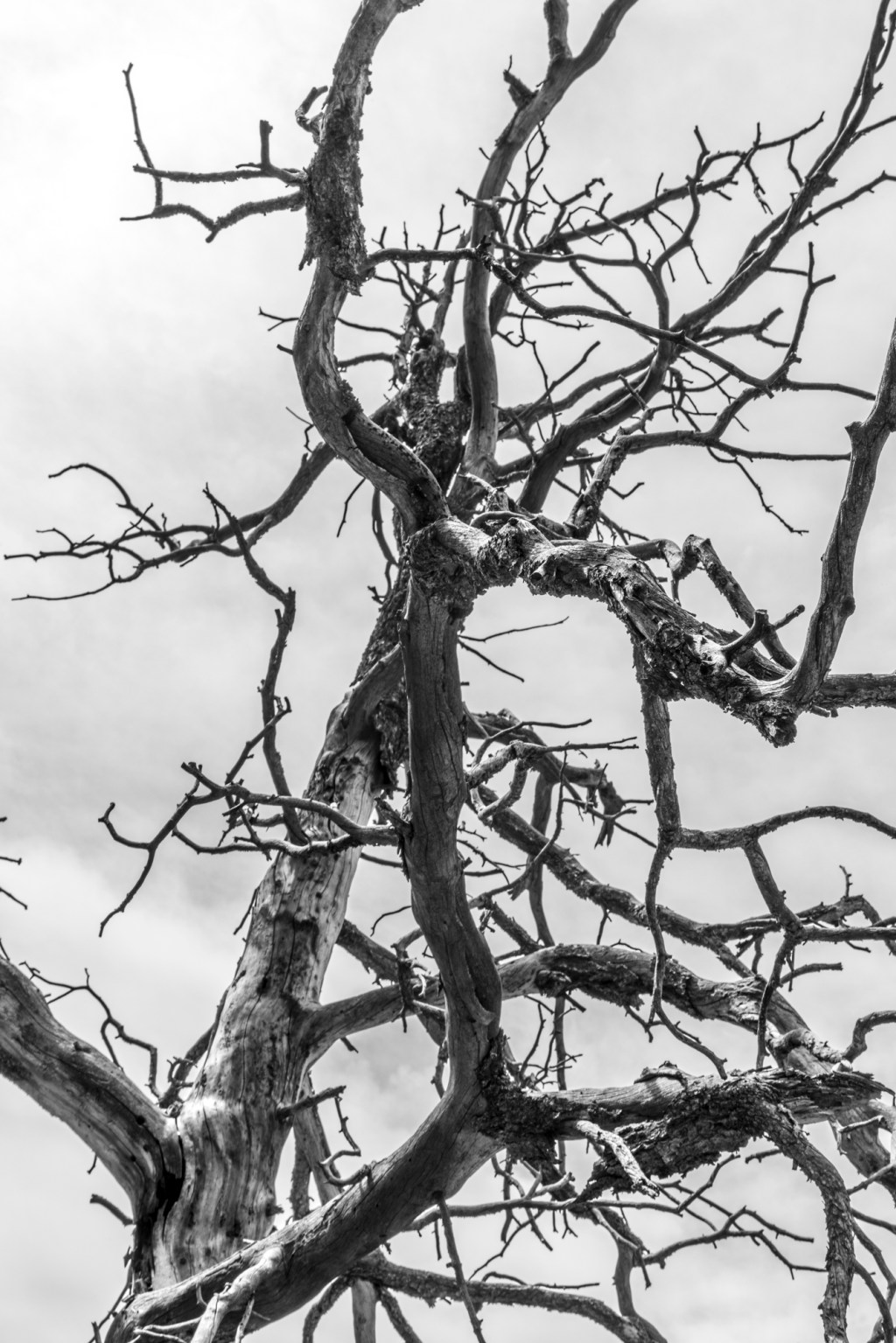
Attributed to the Snakes: An Eco-Memoir
Shelli Rottschafer
2025 is the Chinese Year of the Wood Snake. It is meant to be a time of transformation, wisdom, and personal growth with the snake symbolizing intelligence, mystery, and renewal. In Chinese culture, the snake holds a high place, often associated with healing and rebirth due to its ability to shed its skin. If this snake is a metaphor, I wonder what it symbolizes for me considering the many snakes I have encountered throughout my life.
Fayette Historic State Park
As an extended family, my parents and I, my uncles and their families, my cousins; we all motored west from Michigan’s lower peninsula, diagonal-ed across Lake Michigan’s swells, to finally land on the southern shore of the Upper Peninsula. Big Bay de Noc shelters Fayette, a once-bustling industrial port that manufactured charcoal pig iron from 1867-1891. The 850 acres are now designated a state park. It blends my home-state’s industrial history with the beauty of northern Michigan.
Being curious children, and ready to be released from the confines of our boats, my cousins and I leapt off with our royal blue life jackets draped about our shoulders. We scurried into our Topsiders, and our tanned legs carried us as quickly as possible down the wooden docks. My intrigue led me toward the old buildings, their wooden sides weathered by the lake effect’s wind and rains. My imagination built ships floating in the harbor, tethered for pick-up, delivering mail to workers, resupplying the commissary, and furthering the dream of what would become our America.
The allure of abandoned buildings offered cool shadows to our humid summer heat and drew us inside. We still had the wobble of sea-legs, our inner ears trying to right themselves. Hide and seek is an easy game in darkened corners, only to be discovered by swirls of dust-disturbed air. “I found you,” we’d screech.
Eventually our parents’ call drew us back toward the sun-bleached dock. Our fathers convened in a semi-circle of beach chairs, and readied Busch Lite cans with the peel back tab lofted to their lips. Our mothers, with cherry-tipped Newport menthol cigarettes secured in the corner of their mouths, offered out paper plates of peanut butter and jelly sandwiches with the crusts cut off. We sat dock-side, legs dangling from edge or cross-legged, depending on our own chosen style. We looked down into the water, past the seaweed trendles, in hope of perch down there that we would fish out of the deep for dinner later.
That plan formed too soon. Aunt Nancy peered down dock and motioned quick to Uncle Tim. She pointed with her eyes, and the cherry of her cigarette wiggled east, into the bay. That’s when we saw them. My mother warned us kids to “stay still” as if commanding our geriatric dog. In our child-mind confusion, we stood to have a better view.
Down dock, a long black rope extended. Another began crawling from water surface, up the sunny-sided piling to join it. Those weren’t tar stained dock lines. Memory grows these snakes in size, but in searching what this species could be I am informed that the largest snake in the Upper Peninsula of Michigan is the Black Rat Snake – Pantherophis Obsoletus. It can grow up to eight feet long. They are non-venomous, and harmless to humans, although my Uncle Tim did not know that then.
His long-legged stride bounded over boat gunnel. He rummaged down-below and emerged with a pistol. Two-handedly he pointed down dock. First one shot, and the head of the elongated snake ricocheted. The second, more exposed snake clinging to the piling, plunged into the lake. It still tried to swim, although its lower half twisted awkwardly, connected only by a fragment of skin and scale.
This moment exposed me to the fact that my uncle carried. Then, I wondered why he felt the need to pack a pistol on a family trip. Now, I wonder why he shot, rather than my father, a Vietnam Vet. Or perhaps that is the why. My dad, a terrible shot, would not want to aim over a trembling barrel toward slithering dock lines transformed into reptile. It would only bring back nightmares.
The Benjamins
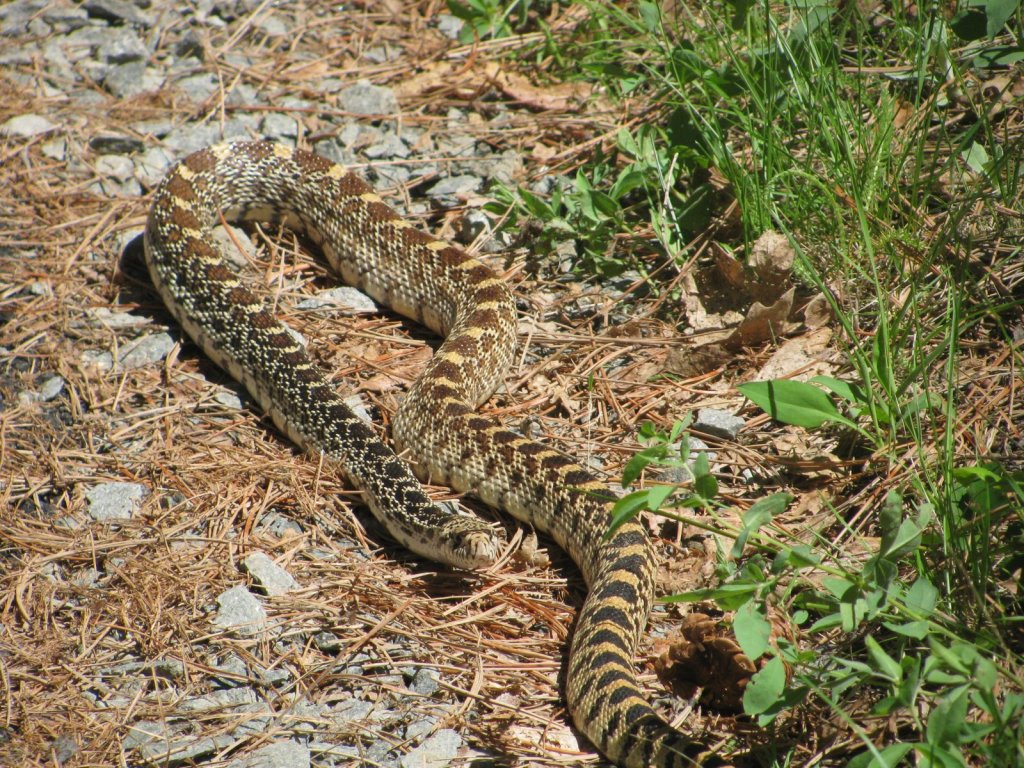
“Masked” – Bullsnake Imitating Rattlesnake, Tali Himmel 2012
The Benjamin Islands dotting Ontario’s North Channel within Lake Huron speckle my childhood memories like clues along a treasure map. These morsels sprinkled my summers. A cherished time of water, imagined worlds, and huckleberry foraging. Once again, wee cousins would be let off-boat, with a gallon Ziploc bag in the hands of the older kids, in order to find the blue-gold that would adorn our pancakes the following morning.
This particular day, the younger generation went one direction, while our fathers went another. Our quest, berries. Their quest, to chop firewood for the evening bonfire where stories of “Yellow Mike” – a sasquatch-like character – would haunt our nights as red-green aurora borealis tucked us in with blanketed skies.
When we came back to the boats with indigo-dyed finger tips and a full Ziploc cache, our parents reprimanded us for going so far. Flummoxed, we saw my mother nurse my father with a Band-Aid to his ankle. He later showed me two needle-sized red punctures that a rattlesnake had rewarded him.
The Eastern Massasauga Rattlesnake – Sistrurus Catenatus – is the only venomous snake in Michigan and Ontario. It is shy, and tries to avoid humans. But this time, as she dream-dozed in the sun on exposed granite rock near low lying juniper the scuffling lumber of six-foot-four men with size 13 Topsiders alerted her to coil. Readied to strike, wrapped in her own curves, she disguises what’s in the insides.
Usually non-aggressive, she’s just a snake after all. Quick enough to puncture my father, she wasn’t quick enough for my Uncle Tim’s hatchet. Chopped in two, she twisted and writhed. My father grabbed a nearby rock and splatted her larger half. Later, holding my mother’s hand, she would lead me to see, the grand reveal. Index finger sized babies exploded from their thin egg sacks and the mother’s decapitated head lay nearby. Uncle Tim had salvaged her yellow-rattle, a talisman guarded in yet another Ziploc.
These stories are now family lore. No need to hide them in low-lying cover of debris, or detritus like the snakes themselves. I have learned that killing snakes seems to be what provoke-humans are determined to do. Yet, what if our “Once upon a time” took the opposite tack? What if our stories of the “Olden Days,” chose to let the slithering dock line be? Doesn’t the wilderness belong to us all, snakes included? If we treat our neighbors with respect and kindness, there exists a believed sense of reciprocity to “live and let live.”
Yet these days, the tension feels tenser. One may ask, how dangerous are snakes, really?
In the case of Massasauga Rattlesnakes most bites are harmless because although the venom is highly toxic, this species’ short fangs can inject only a small volume. The people who do get poisoned are typically harassing the snakes in the first place, like my patriarchs who disturbed her sun-coma nap on a heated granite slab. They did not respect the snake’s “Don’t Tread On Me” coil.
In hindsight, it is my wonder if we left Mother Nature to her own devices, would her snakes rise to strike? Or would they prefer a torpor-ed brumation, an intertwined-slumber with others of their own kind?
A Serpentine Path Down Cebolla Mesa
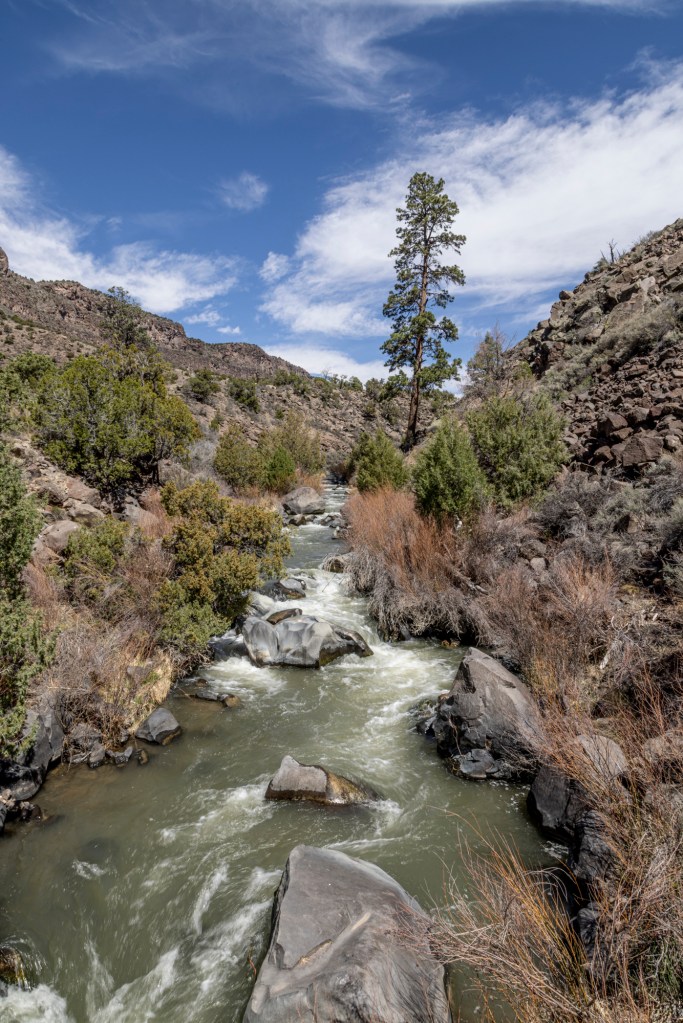
Rio Grande – Daniel Combs 2025
These questions fester and inject fears of snakes into our timid hearts. Emotional jitters seem to be an inherited instinct, a supposed human evolutionary advantage (Spagna 2). Their square-knotted bodies tangled like rope invoke a rush from innards to gizzard; a vertigo sensation as if standing at a precipice looking into the abyss. Does this fear “come with the territory”? Is this code “of living and let live” doomed to unravel like those very coils? (Spagna 3). Does its feared bite lead to a performative paralysis?
These wonders reveal a truth. I am running scared. My courage as a strong, independent, educated woman, who advocates for herself and others, is unraveling. Two years ago, my partner and I moved west, seemingly within a more “live and let live” area. Full of open spaces, and the ability to get lost in mountains. Perhaps this is my own version of covered-debris in which to hide. And with good reason, especially now as it’s “natural” to wrap oneself in those protective curves in order to disguise what is in the inside.
I wonder, do I have an audible rattled-warning? Does my malcontent grow a growl? My woman distinctive sounds make my heart race in awed-fear. It is an instinct that takes charge and coils. Whereas others’ instincts lead to fire, to pull the trigger – to kill.
I try to formulate my fear, because I acknowledge that part of what I am frightened by is what I may allow. Like Nature Writer Ana Maria Spagna attests, “honest people know we’re most afraid of what’s inside ourselves”. The tangled snake searches for warmth and companionship. What the truth reveals is that, “snakes, are snakes, are snakes”. They can be reclusive, provoked, and defensive. They can move fast, hide, and intertwine, all of which is done in the hope to survive another dream-filled day (4).
And on this Summer-like April day, my partner and I head to Cebolla Mesa, just north of Taos, New Mexico. Here, the mesa looks out over El Río Grande. Serpentine switchbacks usher us down cleaved rock. The undulations gravitate us from 7300 feet in elevation and descend a thousand feet until we reach river’s edge. Along the route, lavender Allium Textile, the Textile Onion sprout from sandy soil. Their translucent tulip-like petals rise from the bulbs that give this mesa its name. It is here the confluence of the Red River, which cascades westward down the Sangre de Cristos, meets the north-south flow of the Río Grande.
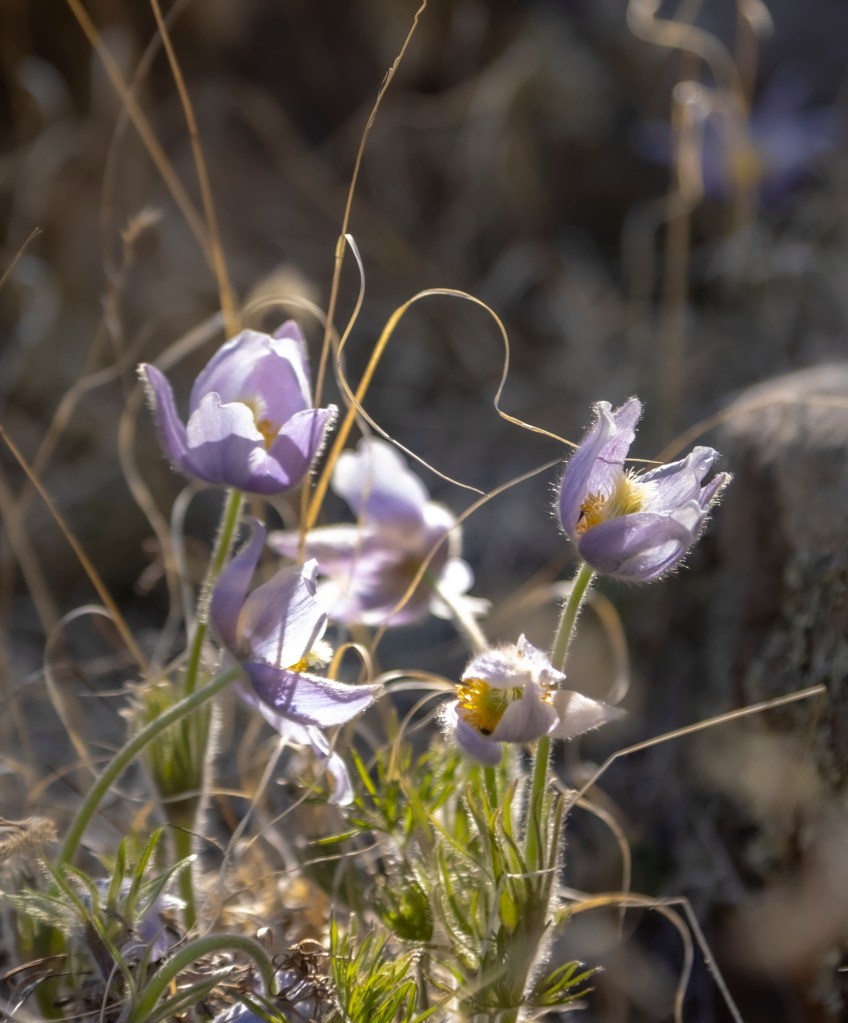
Textile Onion – Daniel Combs 2025
We notice mid-descent tracks that slither. The earth is awakening and from her crevices creepy-crawlies emerge. Pin-prick prints reveal beetles. Crescent curves indicate New Mexico Whiptail Geckos – Aspidoscelis neomexicanus, a female-only asexual-lizard who leave cold-stone nooks for sun-warmed granite perches. Then too, green lichen covered slabs camouflage coiled scales of larger reptiles, which rather be left alone as they stir out of hibernation. We are reminded to tread lightly, because each of us if tempted can’t resist their own self-preservation.
In quiet moments like these along trailside as I huff and puff from my exertion, I think on my life and the numerous snakes I have met. Because 2025 is the Chinese Year of the Wood Snake, does its mysterious metaphor imply humanity’s ability to shed our skin in renewal? Perhaps it is my metaphor: to wake up from hibernation, scuff off the scabs of past wounds, prepare my coils, and ready myself to strike. Is now my moment to act; to resist in the name of Mother Nature, because it is she that is now threatened by the patriarchy that was voted into being.
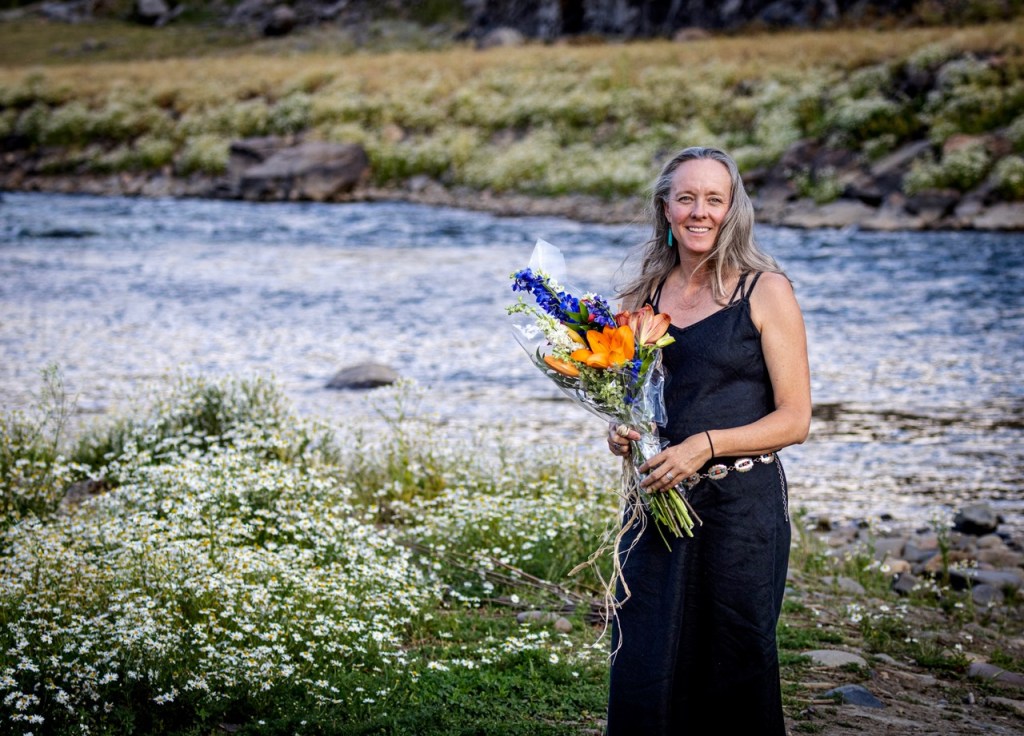
Writer Shelli Rottschafer lives in El Prado, New Mexico and Louisville, Colorado with her partner, Photographer Daniel Combs and their Pyrenees-Border Collie. Shelli completed her doctorate in Spanish from the University of New Mexico, Albuquerque (2005) and her MFA in Creative Writing from Western Colorado University, Gunnison (2025).
You can Follow Shelli and Dan’s work here
Resources:
Spagna, Ana Maria. “Coiled”. The Los Angeles Review. March 12, 2025. (1-5).
https://losangelesreview.org/coiled-by-anna-maria-spagna/
https://www.michigan.org/property/fayette-historic-state-park-and-harbor
https://mnfi.anr.msu.edu/species/eastern-massasauga-rattlesnake
https://www.fs.usda.gov/recarea/carson/recarea/?recid=44126
https://www.swcoloradowildflowers.com/White%20Enlarged%20Photo%20Pages/allium.htm
https://en.wikipedia.org/wiki/New_Mexico_whiptail
https://www.hcn.org/issues/55-12/confetti-westerns-how-the-new-mexico-whiptail-became-a-gay-icon/
 Morrow Point
Leave a comment