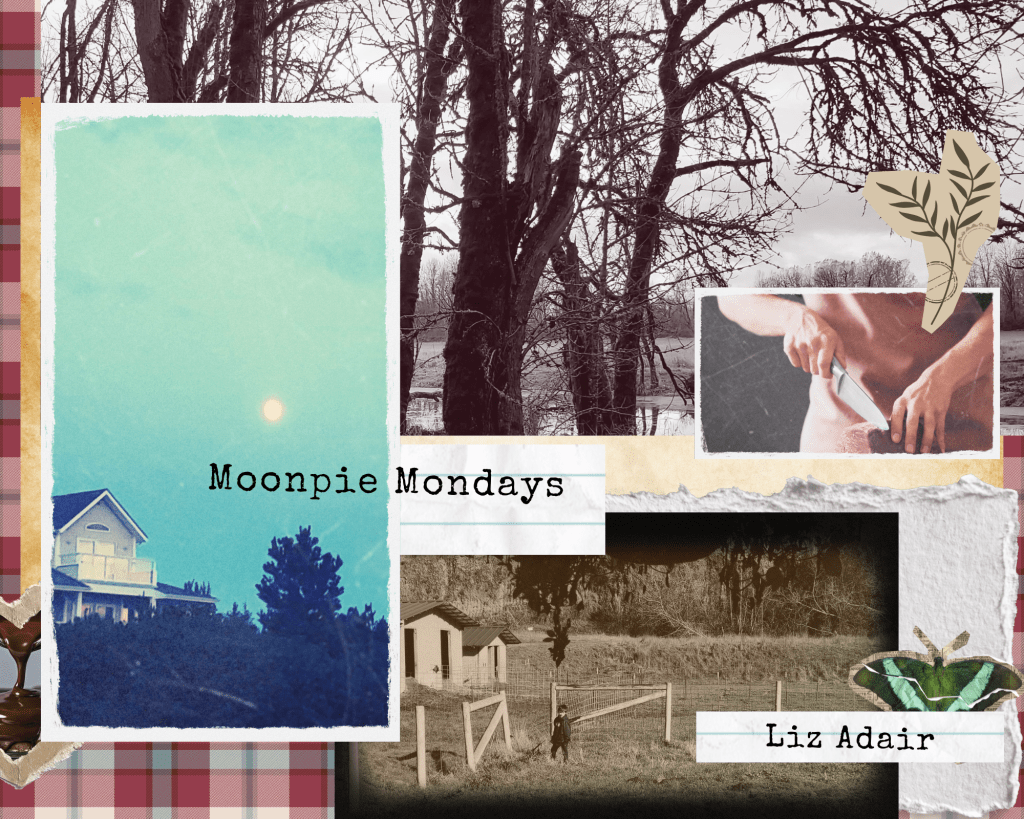
Moon Pie Mondays
Liz Adair
Every Monday, he took half a watermelon, one grilled T-bone, and an unwrapped moon pie to the dead man’s land between wood and yard, where the green sod grass gave way to brown loblolly needles under the shadow of the pines. It was Jack’s job to leave the offering. He’d been doing it all summer, ever since his Mom dropped him off on his grandparents’ doorstep without so much as a see-ya-later-Jack.
It had started with a frantic call to 911. It was just something to do while his Mom slept, an innocent way to pass the time—until three officers busted into their apartment to find a lonely boy, no fire, and no dead body. There were other incidents—a series of videos and a fake gaming profile, but the 911 call was the catalyst. For that, the cops fined his mother hundreds of dollars she didn’t have. For that, Jack’s Mom took his phone and computer. For that, she drove him out of the city and left him to his grandparents’ mercy.
His grandparents’ house, and the small farm attached to it, was dark, with no neighbors and no cell service. They were backwoods people who didn’t even own a computer. Jack had no way to talk to his friends. He couldn’t even call his Mom. The place was a dead zone.
Jack bemoaned this fact to his Grandma over dinner on the very first night of what he called his “inglorious exile from the real world,” and his Grandma laughed in that polite way that an old person does when they do not care about your problems because they have real problems, like the price of eggs and broken air conditioners.
“Oh, Jack, don’t be silly. This is the real world.” Beside her, Grandpa nodded, dully and dutifully. Jack didn’t think he’d ever heard Grandpa utter more than a single word at a time, so this was not unusual.
“But there’s nothing to do here. It’s so boring,” Jack whined. When he saw Grandma’s eyes light up, he knew immediately that he had made a mistake.
“Oh, well, if you’re bored, then I have a dozen chores that need doing. In fact, it is Monday. Isn’t it, Bob?”
Grandpa nodded. “Yup, sure is.”
Grandma clapped her hands together, almost giddily, “Well then, I’ve got a job for you.” She stood from the table and disappeared behind the wooden saloon-styled doors that separated the orange wood-paneled dining room from the kitchen.
She came back with two red-lidded tupperware containers, and a single, unwrapped chocolate moon pie. “It’s dusk now, so you better get a move on,” she said. “Take this to the mouth of the woods where the sunlight is swallowed by the shadow of the pines. You’ll see what I mean when you get there.”
Grandma and Grandpa both stared at Jack expectantly, but he didn’t move. He was sure he’d misunderstood. “You want me to…leave this plate of food in the woods?”
“No, of course not,” Grandma said, “we want you to leave it at the mouth of the woods, like I told you.”
“Seriously?” Jack demanded, “is this a joke?”
“No, son,” Grandpa said, gravely.
“Now, get on with you. Monday at dusk. That’s the way of it,” Grandma started to wave him on, but then she hesitated. She considered Jack for a moment before adding: “Leave the food, but don’t stay too long. Promise me you won’t.”
Jack promised, and he left the food where his Grandma said. The next morning, when Jack went to retrieve the tupperware, he found it stacked where he had left it, and cleaned. This continued all summer. Monday would come round, and Jack would be sent out at sunset with the food: a T-bone, half a watermelon, and a moon pie. Their own dinners were never so rich. They ate vegetable stew, beige casseroles, or beans with bacon. More than once, Jack considered eating the T-bone himself, desperate to taste something other than beans and mayo and mushy white bread. His grandparents ate without commenting on taste or flavor. The only time he saw them open the spice cabinet was to season the T-bone. Jack couldn’t make sense of it, so one night, about two weeks after Jack had arrived, he broached the topic over a bowl of yellow slop his Grandma called chicken casserole.
“Grandma,” Jack said, pricking at the casserole dregs with the prongs of his fork. “Why don’t we ever eat steak? Or the moon pies?”
His Grandma’s fork clattered to the table, and she stared at him, eyes wide. “No! We must never do that. Never.”
Her voice was high-pitched, strained. It scared him. “But why?”
“Boy, you best listen to me,” it was Grandpa who answered, in a stern, angry voice. “This is our family’s burden, and you have to carry it now.”
So, Jack carried it. Every Monday, he took the offering to the mouth of the woods, where the pine shadows were long and ever-present. He called this “feeding the beast,” and it was both his favorite of the farm chores, and the strangest. Jack placed the goods at the cusp of darkness, the elbow of needle-leaf undergrowth where the woods bent inward, and he waited. Some days, he left quickly, feeling watched and uneasy. Other times, he lingered and peered into the darkness, trying to see what lived there.
The rich scent of fresh steak made his mouth water. Even through the heavy plastic, he could smell the meat and the spices, the fragrant herb butter—but Jack never touched it. He didn’t want to get in trouble. He had made some mistakes, but Jack never meant to hurt anyone. “I want to be good,” he’d told his Mom the day she dropped him off, “I just don’t know how. I’m trying. Please, don’t leave me here.” His Mom had not been moved, but Jack was a good boy at heart, and he tried to listen to his grandparents. He tried to do the right thing. If I do what they say, maybe I can go home, he thought.
The truth was that Jack had thought this way long before coming to the farm. For a long time, he’d made trouble, and for an even longer time, he had tried not to. As a boy, when his parents argued, he thought: if I am good, maybe they’ll love me. And when his Dad left, Jack thought: maybe he’ll return home, if I act better. And as his Mom drove away, he couldn’t help but think: if I am good, she’ll come back for me. But Jack was never good, and no one ever came back.
On his tenth Monday living at the farm, Jack found the photograph. It was an old one, nostalgic and orange, printed on a thick square of yellow cardstock. In it, he recognized his Grandma, Grandpa, his Aunt Marie, his Mom, and himself. The boy looked like him, so much so that Jack almost couldn’t believe it. The shape of the face, the thin mouth and sharp nose, and something in the eyes. Something dark and deep, a longing that Jack recognized as his own.
“Oh my,” his Grandma said when he showed her the picture, “It’s been so long—where did you find this?”
I don’t remember, Jack realized, unsettled. When he woke, the photo was in his hands, sticky with sweat, but he had no recollection of how it got there. I must have found it last night, but why can’t I remember? Jack’s stomach churned.
His Grandma lovingly traced the boy’s face with her forefinger. “He was a sweet boy. You do look a bit like him. My son, your mother’s younger brother. He was the youngest of our three.”
“I don’t have an Uncle,” Jack said, confused. His Mom had never mentioned a younger brother.
“No,” his Grandma said, tucking the photo into her apron pocket, “no. You don’t. He’s been gone a long time.”
“What happened to him?” Jack’s heart hammered in his chest. He feared her answer.
His Grandma looked away, unable to meet Jack’s eyes. Her lips trembled, and in a sad, broken voice, she said, “He was just so lonely, Jack. So lonely. It ate him alive.”
That night, alone in his bed, Jack thought about the photograph and his Uncle’s unsmiling face. There was a clawing, empty feeling in Jack’s belly. The feeling had always been there, he remembered, even when he was young. It had grown worse when his Dad left, and living on the farm, it had grown stronger still. Every night, he could feel it gnawing at his heart. At first, he thought it was hunger. But it wasn’t. It was the longing. Loneliness. Emptiness. He had a pit of shadows in him, dark and unending, and he needed to fill it. But with what?
Jack tried to fill the pit. He put his all into the farm chores. He talked to his Grandma about needlepoint, and he learned how to drive a stick shift. He wrote and mailed letters to his friends, though he had to go to the library 40 minutes away to check his school email for the addresses. Jack tried looking for more photos of his Uncle, but he didn’t find any. There were hundreds of old pictures of his Mom and her sister—but his Uncle was nowhere to be found.
Stranger still, when Jack asked his Grandpa about it, the old man hadn’t known what he was talking about at all.
“What boy?” he demanded. “I never had a son.”
“But Grandma said—”
Grandpa pierced him with a long, unnerving stare. “I said I never had no son. Must’ve been someone else in the photo.”
But Jack didn’t give up easily. “Why would Grandma lie? Who was that boy?”
“How should I know?” Grandpa asked. “Maybe it was you. You say he looked a bit like you.”
“But I’m not old enough. My Mom was a kid in the picture.”
His Grandpa only shrugged. Grandma refused to talk about his Uncle again, and even at the library, Jack found no proof the boy had ever existed. In desperation, he mailed his Mom a letter, asking about her brother—but she never responded. He even tried sending a letter to his Aunt Marie, but it came back with a return to sender notice. The address was wrong, even though his Grandma had sworn it was right.
One cold morning, Jack woke to darkness and whispers. Soft, strained words slipped through the dark and came to him from the hallway beyond his room. He heard his grandmother’s tremulous voice first: “Oh Bob, the payment. I just can’t. Not again.”
“We knew the cost,” his grandfather said. His voice was pitched so low that Jack could barely hear him through the thin, old walls of the farmhouse. “We knew when we came here, when we took on the debt.”
“It’s not right,” she replied.
“A good man pays his debts,” Grandpa said.
“It’s not right,” she said again, louder, “I won’t do it again.”
“You will,” Grandpa said, “and so will I. Again and again, forever. As it has always been, so will it be again. It is the same, Nora,” he continued, “don’t cry over what’s already done. He is the same, and this is his place, his due. Deep down, he knows.”
The words confused Jack, who laid in his bed for hours trying to puzzle them out. His grandparents were in debt. That wasn’t so unusual. Lots of people had debts. But what kind of payment did they have to make? He imagined all the horrible things his Grandma and Grandpa must have done to make their payment—they didn’t eat much. They always wore old, threadbare clothes that were decades out of fashion. Then his mind took darker turns. What if his Grandma had to sell herself? His Mom never liked to talk about her childhood on the farm—maybe she’d been made to work for money in horrible, unimaginable ways. And there was something else, something that nagged at Jack: his missing Uncle. Had they sold him too? Had they done some black-market adoption, sold him to some cruel person?
No matter how much he turned it, Jack couldn’t make sense of his grandparents’ early morning whispers. Things on the farm went on as they always had. Jack settled in well and tried not to think too much about his missing Uncle or his family’s debt. Everything was fine, except for the dreams. Every night, Jack looked into a huge, dark mirror. It was black and smooth, stretching below him in all directions. From every angle, he could see himself—lanky legs with sneakers, his hands with dirty nails bitten to the quick, his face, pale as the moon. Every night, he reached a hand towards the glass, wanting to feel its smooth, endless surface, and every night, he woke before he could.
With all the strangeness going on, “feeding the beast” had become Jack’s solace. It was a simple, peaceful chore, always the same, undeviating, and that gave him comfort. At first, Jack turned back as soon as the offering was laid down, but as the weeks stretched on, something changed. Jack began to linger at the mouth of the woods. He watched and waited. Jack could feel the thing beyond the shadow, and he knew that it watched him back. It’s waiting for me, he thought. He stopped asking about his Uncle. He stopped questioning what they were feeding and why—and wondered instead what it would be like to eat moon pies in the dark.
The dream changed too. Now, when he reached out, his fingers found water. It wasn’t a mirror at all. It was a pond, and when he dipped his fingers into the liquid, a thousand ripples extended in every direction, and in every ripple, there was a boy with his face. A hundred boys stared back at him. A thousand versions of Jack drowned in the darkness. The light dimmed, and the clear pond became opaque, filmy. The faces disappeared, one by one, until only Jack remained, flanked by an unending forest of pine shadow. Then his face vanished too, sunk to the depths, given to whatever lived below the surface.
The dream scared him more than anything. The dreams were somehow worse than the photograph or the whispers, stranger than the moon pies and T-bones on Mondays. Jack thought about leaving the farm, catching a ride back to the city, but he couldn’t bring himself to run away because of a bad dream. His grandparents would be worried, and his Mom would be so angry that she’d never let him come back home. Just be good, Jack, he told himself. Just be good. More and more, Jack looked forward to his Monday chore. He was drawn to the mouth of the woods and felt comfort there. He had always felt out of place in the city, alone in the apartment with only his Mom for company, and he felt lonely on the farm too. But when he sat at the mouth of the woods and stared into the shadows, he felt peace.
It happened so slowly that Jack didn’t notice at first. His fear gave way to fascination, and he forgot what he’d promised his grandma that very first Monday. He sat long hours in the dark, talking to the thing beyond the shadow. It was nice to have someone to talk to. It never talked back, but it listened. He knew it did. Just like he knew, or at least suspected, that the real world existed in the darkness, and the thing beyond the shadow waited for him there.
It has always been waiting for me. Jack had lived on the farm for so long that he was beginning to feel like he’d always lived there. His Mom, his friends, the apartment in the city— all seemed worlds away, a time and place apart from him. Had any of that life really happened? Had Jack ever existed at all? He wasn’t sure. All that mattered was the world beyond the shadow, and the things that listened to him in the dark. The dreams stopped. Everything stopped. Jack’s worries faded away while his grandparents watched, uneasy and knowing. Jack craved meat. Jack stared at the moon with hunger.
They will not sacrifice me, he knew. Jack had begun to suspect their purposes, and they thought it would be easy, now that the shadows lived inside him again. He remembered. Staring into the mouth of the woods, he’d learned the truth. He had lived the lives of a thousand Jacks, murdered in their beds, butchered and given to the pine shadows as payment.
As it has always been, so will it be again, his Grandpa had said. But Jack would be no one’s payment. I will prove him wrong. Jack stopped sleeping. At night, he watched his bedroom door with wary eyes, expecting betrayal. Once, his Grandma opened the door. Moonlight streamed through the window, glanced off her glasses, and Jack saw her eyes—glistening with unshed tears, and the gleaming blade of a butcher knife clenched in her fist. But when she saw Jack was awake, watching—she closed the door and walked away. The shadows had driven all Jack’s fears away. Only truth remained. Truth, and the plan. They will not have me. Not this time. It would be different this time.
On his last Monday at the farm, Jack took the offering to the place where the pines yawned and the shadows lived under the trees. He sat cross-legged on the ground and lifted the red lids from their containers. He ate the steak with his bare hands. It was cooked rare and bloody, but he didn’t care. He let the pink juice drip down his face, and he gnawed the meat to bone and marrow. Then, Jack took the watermelon in hand. He ate it the same way, tearing into the red, glistening pulp with his teeth. He ate his fill, all the way down to the white rind. Jack saved the moon pie for last. He stood under the shadow of the pines and ate the whole moon in three bites. With his hunger finally sated, Jack walked into the mouth of the woods.

Liz Adair received her B.A. in English from the University of Alabama in 2016 and her MFA in Creative Writing from McNeese State University in 2020. Her poetry has been published in Strange Horizons, Diode Poetry Journal, Anti-Heroin Chic, and Jabberwock Review. Her fiction has been featured in Creepy podcast.
Notes from our Editor:
This wonderfully spooky coming of age story drew me in from the start. From something as simple as an offering, to family, to darkness, to being who you really are, the layering of this piece is astounding. I hope you find what I found, even if it’s just a good old fashioned Moon Pie.
Roxanne Skelly
–


Leave a Reply